In the News

In the News

Most people know Savannah Guthrie as a Today show anchor, but she is also an attorney who graduated from Georgetown Law School. (She was a few years behind me.) She is going through a horrible ordeal right now because her mother is missing, and there is evidence that her mother may have been abducted. I mention all of this because there is an Apple technology connection to this story. As noted by Andrew Orr of AppleInsider, investigators were able to pinpoint the time when she may have last been in her home because she has a pacemaker that communicates with her Apple Watch, even when she is not wearing the Apple Watch. By noting when the data stopped syncing, authorities have some evidence of when she may have left the premises. With technology like an iPhone, Apple Watch, and AirPods that we often keep very close to our bodies, and with those devices syncing with other devices and capturing information such as heart rate and location, mobile technology can play a big role in recreating what may have happened in the past—something that is frequently an issue in civil and criminal lawsuits. And now, the news of note from the past week:

  • As I noted earlier this week, Apple just finished its best financial quarter ever, and Apple CEO Tim Cook said that “demand for iPhone was simply staggering.” One reason for that was a big increase in iPhone sales in China. Zeyi Yang of Wired explores some of the reasons why, including: (1) the baseline iPhone 17 model has a ton of features that used to only come in the Pro model, and (2) the baseline iPhone 17 model was priced low enough to qualify for a new Chinese government subsidy aimed at stimulating the economy. Those sound like valid reasons, but I’ve also heard it frequently said that many customers in China prefer a smartphone that stands out as looking different and new, and Apple is now selling an orange Pro phone and an iPhone Air, two models that definitely look like new models.
  • Simon Jary of Macworld reviews the new second-generation AirTag. And in case you missed it, here is my review.
  • Two years ago this week, Apple released the Apple Vision Pro. Many news reports about this anniversary are similar to this one by Hartley Charlton of MacRumors in that they criticize the device as not yet being a blockbuster. I think they are missing the point. I was excited about this product when I bought one two years ago, and I still love using it today. But more importantly, the Apple Vision Pro is a preview of the future, and I’m thrilled that Apple is working on that future right now, just like the first Mac, first iPhone, and first iPad were all just a tease for much better products that would come later.
  • A fascinating Vision Pro game was released yesterday: Retrocade. As Giovanni Colantonio of Polygon notes, it brings a 1980s arcade into your home because you can play full-size arcade games as you stand in an immersive environment that looks like an arcade. I only played with it for a short period of time last night, but it was so much fun! One of my favorite games from the early 1980s was Frogger, and there I was, playing what looked like the actual Frogger game. The in-game graphics and sounds were perfect, and better yet, I could also look at all of the details on the cabinet of the arcade game. When I showed it off to my son, his first reaction was “What is Frogger?”—clearly, I have failed in my duties as a father if he doesn’t recognize that game, although he did recognize some of the other titles in the collection such as Space Invaders and Pac-Man—but minutes later, the two of us were taking turns helping the frog to dodge traffic and laughing at each other’s mistakes, just like I would do with my middle school friends way back when. Thanks, Apple, for the walk down memory lane. I look forward to playing with this one some more. (Although I do agree with Colantaonio—they should add Ms. Pac-Man, which was another one of my favorites.)
  • In a post for Six Colors, Shelly Brisbin discusses the Transit app, an app that provides lots of useful information when you need to ride a bus or train.
  • Eric Berger of Ars Technica reports that NASA will now let astronauts take their iPhones to the moon.
  • The title of this article by Andrew Zucker in the Wall Street Journal is a little bizarre—Call Screening Is Aggravating the Rich and Powerful—but the article does a decent job of describing how the new iOS 26 calls screening function can improve your experience with an iPhone.
  • You can instruct an iPhone to take pictures in both RAW and JPEG format. RAW format can be useful if you want to do advanced editing of the photo, but the RAW format takes up a lot more space than a picture in JPEG format. If you want to delete those RAW images while keeping the JPEG version, Glenn Fleishman of Six Colors explains how to do so.
  • I’m a big fan of the UGREEN 3-in-1 Foldable MagFlow Wireless Charger ($139.99 on Amazon) that I reviewed a few months ago. It can charge three devices, and it folds up for travel. Juli Clover of MacRumors reviews a new and similar device from Anker called the Anker Prime 3-in-1 Wireless Charging Station ($149.99 on Amazon). The Anker device includes a quiet internal fan to keep an iPhone cooler while charging, and in some circumstances, this could result in faster charging.
  • If you want to get some of Apple’s Apple Watch bands at an amazing 70% discount, Woot is once again selling $50 Apple Solo Loop bands for only $14.99 and $100 Apple Braided Solo Loop bands for only $29.99. I have taken advantage of these occasional sales on Woot many times in the past to try out different band colors and sizes.
  • In a post on Six Colors, Philip Michaels recommends using a $5 one-day Sling Day Pass when you want to watch a specific sporting event or other program on your Apple TV after you have “cut the cord” with a cable company.
  • Apple TV had a press day earlier this week, and Apple revealed lots of information about its upcoming shows. Wesley Hilliard of AppleInsider shares five new TV shows and six new movies that were announced, along with eight returning series.
  • One of the shows currently airing on Apple TV that I have been enjoying is Season 3 of Tehran. David Snow of Cult of Mac shares some reasons you should watch Tehran if you haven’t started yet.
  • Here is a great video from Apple called Humans of Apple TV. It’s a slideshow with some behind-the-scenes pictures taken from Apple TV productions. Nicely done.
  • Ryan Christoffel reports that you can add a subscription to Peacock—allowing you to watch the Super Bowl and the Olympics—to your Apple TV subscription for as little as $2/month.
  • Speaking of the Super Bowl, in an article for Six Colors and Macworld, Jason Snell describes Apple’s long history with that game.
  • And finally, Apple often sponsors filmmakers who create short films using an iPhone. A great one was created to celebrate the Chinese New Year called Glad I Met You. It runs about 11 minutes, and it is worth watching.
Review: Apple AirTag (second generation)

On April 30, 2021, Apple began selling the original AirTag. As I noted in my review, the product did a great job of helping you to find a lost (or stolen) item. In the almost five years since then, the device has gotten even more useful. There are now lots of third-party accessories that work with an AirTag, making it easy to attach an AirTag to almost any type of item. Also, you can now share an AirTag’s location with third parties that you trust, such as an airline. Apple recently announced that, according to “a leading IT provider for airlines … using Share Item Location has reduced baggage delays by 26 percent and reduced incidences of ‘truly lost’ or unrecoverable luggage by 90 percent.”

Last week, Apple started selling the second-generation AirTag. It is just like the original AirTag, but a little better, for the same price. I purchased a set of four of the new AirTags and compared them to the original AirTags that I’ve been using for years. Sure enough, the new ones are a little better because they make it easier to find a lost device.

Louder

If I cannot find an item with an AirTag attached, the first thing that I do is open the Find My app on my iPhone and tap the specific AirTag in the Items tab. A map shows me where the AirTag is located. It is typically in the same place that I am located—such as in my house—so the next thing that I do is tap Play Sound and listen for the beep. That is usually enough for me to remember that, for example, I left my car keys in my jacket instead of in their usual location.

Apple says that the new AirTag uses an updated internal design that makes it 50% louder. Sure enough, in my tests, the speaker is louder, and that makes it a little easier to locate the AirTag.

Ben Lovejoy of 9to5Mac notes that, unlike the original AirTag, which has a chirp in the key of F, new AirTag chirps in the key of G, and you can hear the difference thanks to a video embedded in his post.

Improved Precision Finding

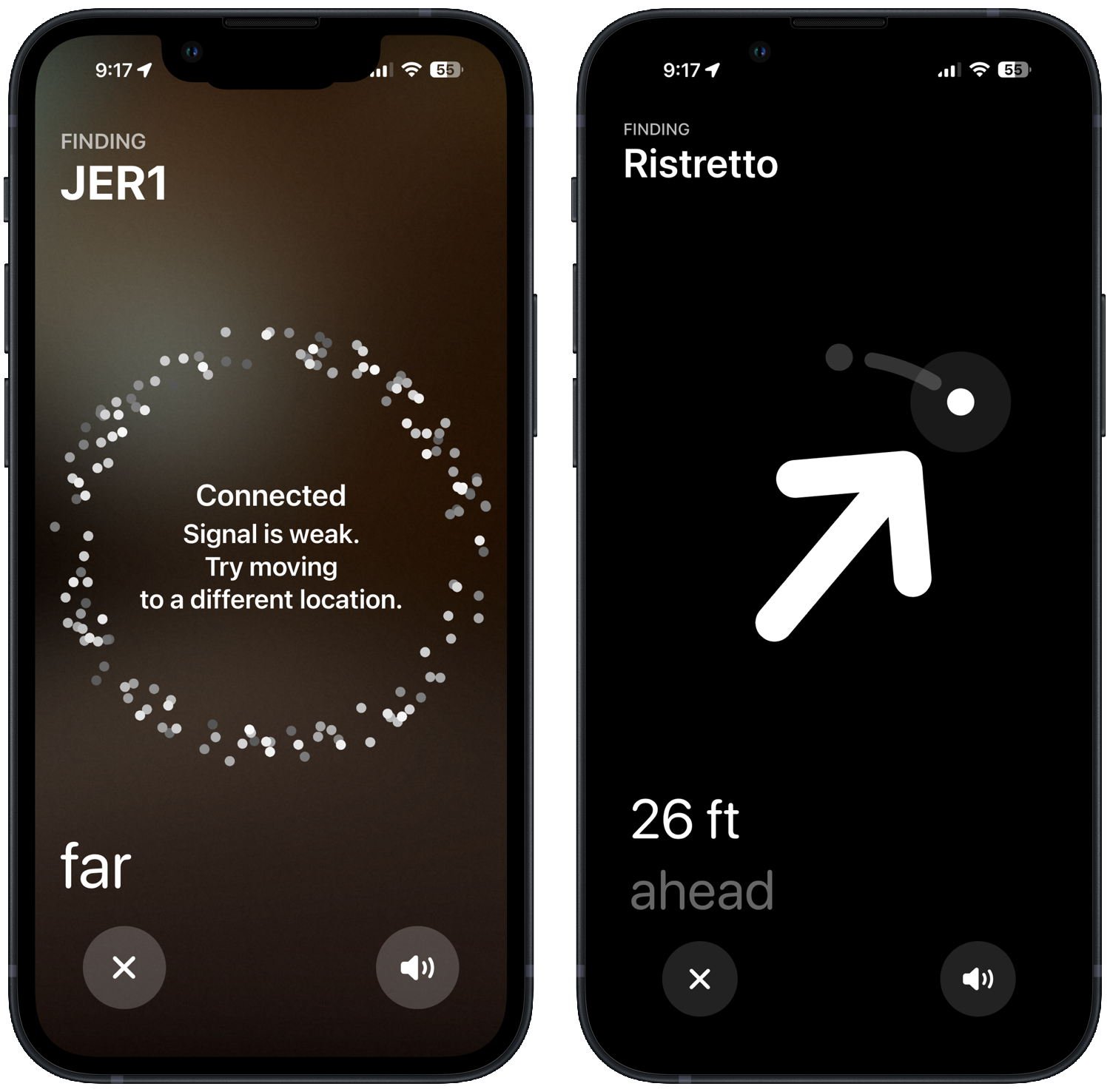
If playing a sound isn’t enough for me to locate an AirTag, the next thing that I do is tap the Find button, located right next to the Play Sound button, and then walk around. The Find My app will indicate when it can sense the AirTag and then, as you get closer, will display a huge arrow that points to the AirTag and says how far away it is.

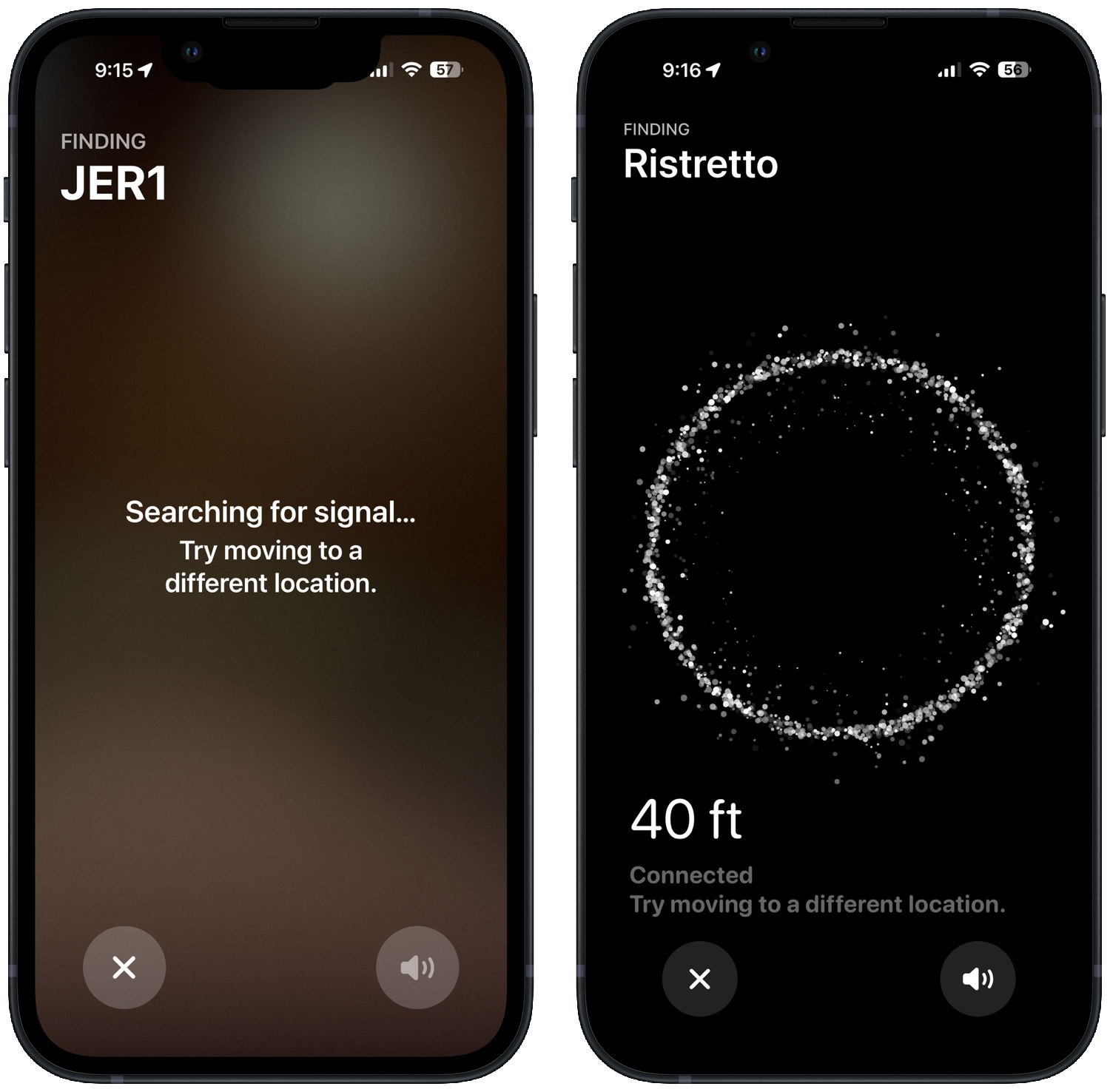
For the original AirTag, that feature used Apple’s Ultra Wideband chip. For the new AirTag, the feature uses Apple’s second-generation Ultra Wideband chip, which Apple says will guide you to a lost AirTag frup up to 50% further away. In my tests, it definitely worked better.

I ran some tests in which I “hid” an old and a new AirTag right next to each other. In the same spot where my iPhone would tell me that it was still searching for a signal from my older AirTag, my iPhone was able to get a signal from the newer AirTag and tell me how far away it was.

As I moved around even more, eventually the old AirTag would appear to my iPhone with a weak connection, whereas in the same spot, the newer AirTag showed me an arrow to lead me to the exact location.

I saw this result over and over again. Not only was it easier to find the new AirTag from farther away, but it was also easier to find it when there were walls between me and the AirTag. The radio in the new AirTag is better.

To be fair, I don’t mean to imply that I never would have found the older AirTag. I just needed to spend more time walking around my house until I got close enough to get a signal. And of course, if I was far enough away, my iPhone wouldn’t sense either the old or the new AirTag. The point is simply that the new AirTag was easier and faster to find. That’s nice.

Better Bluetooth

What if the item with an AirTag is located far away from you? For example, what if I left an item in my office and I am now back in my house?

Each AirTag has a Bluetooth radio in it, which means that it can talk to other Bluetooth devices that are within the vicinity. The AirTag sends out a number that changes from time to time, and if another iPhone passes within Bluetooth range of that device, it will notice the AirTag’s number and notify Apple that a certain AirTag number was seen at a certain place and time. Because there are so many iPhones in the world, when you use the Find My app to search for an item, there is a good chance that you will learn of the location simply because an iPhone has passed by it. All of this happens without alerting the owner of the iPhone that happened to sense your lost device, so there are no privacy concerns.

The original AirTag could often be sensed by an iPhone that was 30 to 50 feet away. Apple says that the new AirTag uses “an upgraded Bluetooth chip expands the range at which items can be located.” Apple didn’t provide any specific quantification on how much better the new AirTag works. I haven’t yet been able to tell how much of a difference this makes, and I haven’t yet seen any published reports in which anyone else has been able to quantify the difference. Nevertheless, I presume that there will sometimes be circumstances in which the original AirTag could not be found but the new AirTag can be found because of the Bluetooth improvement.

Same size

When Brett Burney and I discussed the new AirTag during the latest episode of the In the News podcast, Brett said that it was unfortunate that Apple didn’t use this opportunity to change the shape or size of the AirTag. I see that Juli Clover of MacRumros said something similar in her review.

I disagree. By keeping the new AirTag the same size and shape, Apple ensured compatibility with all of the existing AirTag accessories. For example, I have been using a Belkin AirTag holder for my keys for almost five years, and it was simple to pop up my old AirTag and replace it with the new one. Suddenly, my keys became even easier to find.

I understand that sometimes it is nice to have something that works like an AirTag but is smaller. However, we already have that. Apple lets third parties make devices that work with Find My. For example, I use a thin device from Eufy that is about the size of a credit card in my wallet: the Eufy SmartTrack Card (my review), which is only $16.88 on Amazon.

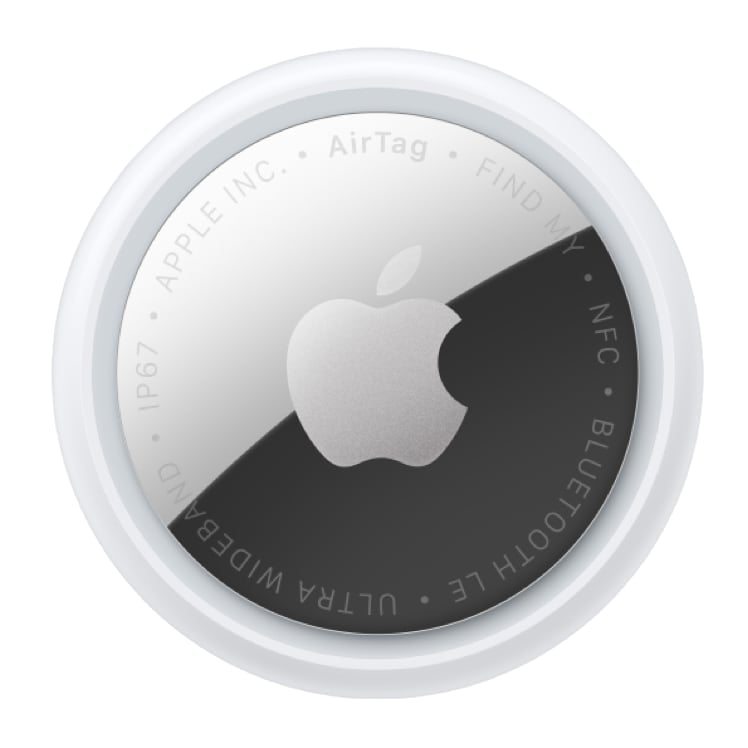
Accordingly, I consider it an advantage that a new AirTag looks essentially the same as an original AirTag. In fact, the only way to tell them apart is to look at the back of the AirTag. If you see text in UPPER CASE, it is a second-generation AirTag.

Apple Watch Precision Finding

With an original AirTag and the new AirTag, you can use the Find Items app on an Apple Watch to get directions to the general location of the AirTag. However, that app does not support Precision Finding—the feature where you get an arrow pointing in the direction you should walk and the distance in feet.

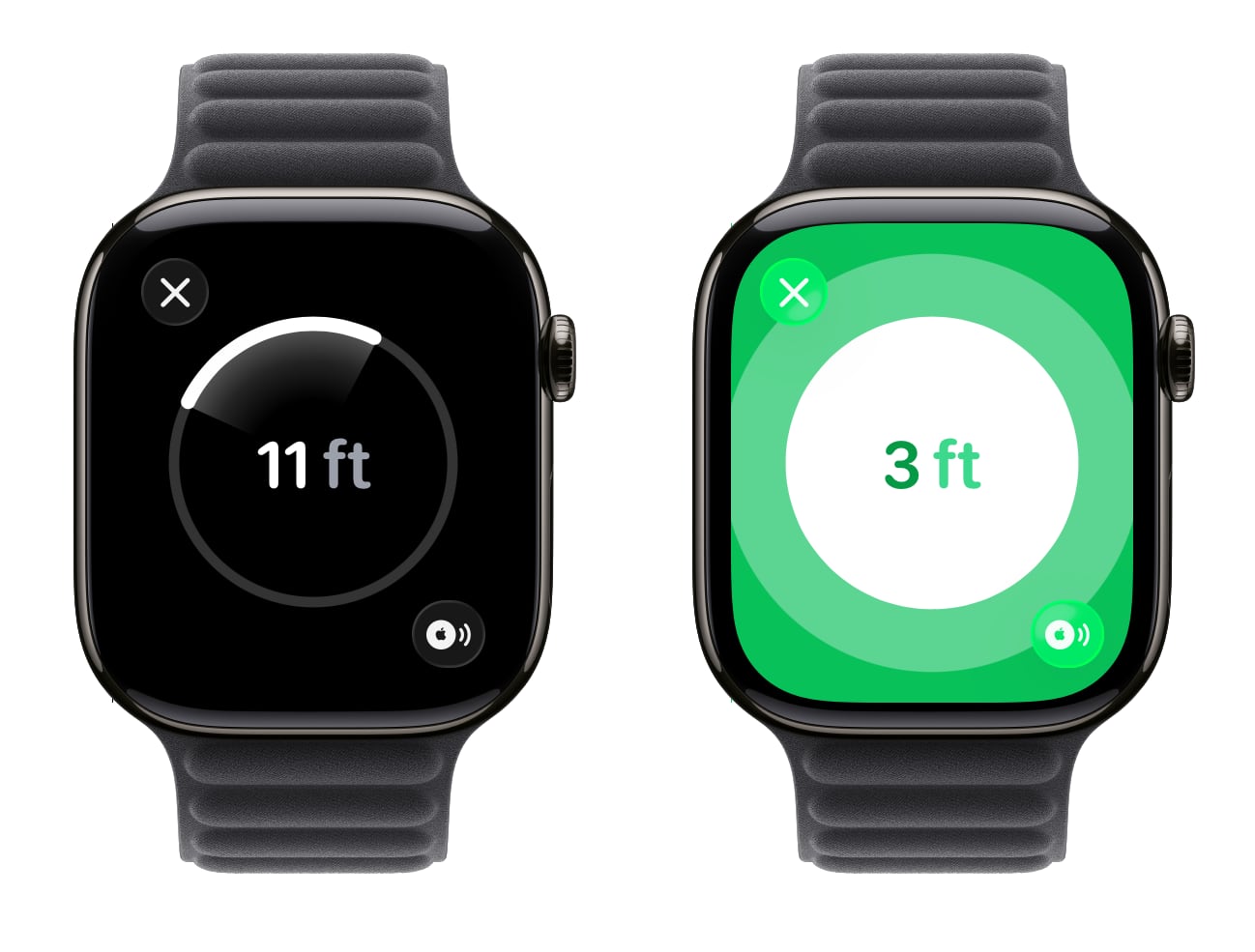
With the new AirTag and an Apple Watch Series 9 or later or Apple Watch Ultra 2 or later, you can now use Precision Finding on an Apple Watch, making it easier to find an item when your iPhone is not around. However, Apple did not add this support to the Find Items app on the Apple Watch, which seems bizarre to me. Instead, you need to follow the steps on this page of the Apple website to add a specific item to the Control Center of the Apple Watch, one for each second-generation AirTag. Then, to use Precision Finding, you swipe up from the bottom of an Apple Watch screen and select the Control Center item for that specific AirTag.

This new feature works. Instead of an arrow, you see a circle with an arc indicating which direction to walk to get closer to the second-generation AirTag. And when you get to within a few feet, the display changes, similar to the way it works on an iPhone.

I’m glad that Apple added this feature, but I cannot figure out why they put it in the Control Center instead of the Find Items app on the Apple Watch, which is where it belongs. I’m sure that many owners of a new AirTag will have no idea that this new feature even exists. My hope is that a future update to the Find Items app on the Apple Watch will add support for this feature.

Conclusion

I don’t think that you need to rush out and replace all of your original AirTags. The first-generation AirTags will continue to work just fine. But if there is an item that is especially important to you, something for which it would be helpful if the item could be even easier to find, it is nice to have the option to use the improved second-generation AirTag. I’ve already made that change for my keys and my Tom Bihn bag that I take to work every day. However, I’m going to continue using my first-generation AirTags in situations in which I don’t need the latest and greatest. After purchasing these new AirTags, I now have four additional AirTags in my possession, so I can use AirTags for even more items.

Click here to get AirTag (second generation) from Amazon ($99 for four).

Click here to get AirTag (second generation) from Amazon ($29 for one).

Apple 2026 fiscal first quarter — the iPhone and iPad angle

A few days ago, Apple released the results for its 2026 fiscal first quarter (which ran from September 28, 2025, to December 27, 2025, and did not actually include any days from calendar year 2026) and held a call with analysts to discuss the results. The fiscal first quarter is always Apple’s best quarter of the year because it includes holiday sales. This time, the fiscal first quarter was also Apple’s best fiscal quarter of all time, with a record revenue of $143.8 billion, up 16% percent from the 2025 Q1. That is just an astonishing number, and much higher than the last two record quarters: 2025 Q1 ($124.3 billion) and 2022 Q1 ($123.9 billion). But as impressive as the number is, the financial performance isn’t the real reason that these calls interest me. What interests me is that this is one of four times a year when Apple provides some indication of how well its products are selling and answers questions from a bunch of analysts. I’m always especially curious to discover what Apple has to say about the iPhone and iPad and related technologies. If you want to get all of the nitty-gritty details, you can listen to the audio from the announcement conference call on the Apple website, or you can read a transcript of the call prepared by Jason Snell of Six Colors. Snell also created a number of useful charts that put Apple’s financial announcements in perspective over time. Apple’s official press release is here. Here are the items that stood out to me.

iPhone

  • Apple CEO Tim Cook started the call by saying that “demand for iPhone was simply staggering, with revenue growing 23% year-over-year and all-time records across every geographic segment.” Specifically, iPhone revenue was $85.3 billion, making it by far the best iPhone quarter ever.
  • Cook said that Apple currently has its “strongest iPhone lineup we’ve ever had, and by far the most popular.” He mentioned all of the current models—iPhone 17 Pro, iPhone 17 Pro Max, iPhone Air, and iPhone 17—but did not identify how any specific models were selling. To be clear, Apple never releases that data, so outsiders just have to speculate on which models are the most popular.
  • Cook said that demand for iPhones is exceeding supply primarily due to constraints in processor manufacturing. (Apple designs the A19 and A19 Pro processors used in the latest iPhones, and they are manufactured by Taiwan Semiconductor Manufacturing Company (TSMC).) Cook said that Apple wasn’t willing to comment publicly on when supply is predicted to catch up with demand.
  • Cook said that Apple’s recent collaboration with Google and its Gemini AI model would be used to power a more personalized version of Siri.
  • Cook said that Visual Intelligence is one of the iPhone’s most popular AI features.
  • Cook said that Apple sees a future for both on-device AI and AI that uses Apple’s secure Private Cloud Compute servers. Cook said that both of those differentiate Apple from other companies because of Apple’s focus on user privacy.
  • Cook said that a big reason for the all-time record iPhone sales was strong demand in China, where Apple set an all-time revenue record. Cook cited a third-party report that iPhones were among the top three smartphones in urban China during the quarter.
  • Cook said that India is the second-largest smartphone market in the world. While Apple had its best-ever quarter in India, it still has only a modest market share of the overall market and thus sees significant growth opportunity in India.

iPad

  • iPad revenue was $8.6 billion, which is up 6% from this time last year.
  • Cook mentioned that there were more iPad upgrades in the past fiscal quarter than ever before.
  • Apple’s CFO Kevan Parekh said that AstraZeneca is rolling out over 5,000 M5-powered iPad Pros to its pharmaceutical sales team.

Other

  • Apple’s revenue in its services category was an all-time record $30 billion, which is up 14% from this time last year.
  • Cook said that Apple saw a 36% increase in people watching Apple TV compared to this time last year. Cook said that was because of its popular shows such as Pluribus.
  • Cook said that Apple Music reached an all-time high in the number of listeners and the number of new subscribers.
  • Cook asserted that, in the past year, Apple Pay eliminated more than $1 billion in fraud.
  • Cook said that App Store developers have earned more than $550 billion since 2008.
  • Parekh said that there are over 2.5 billion Apple devices currently in active use.